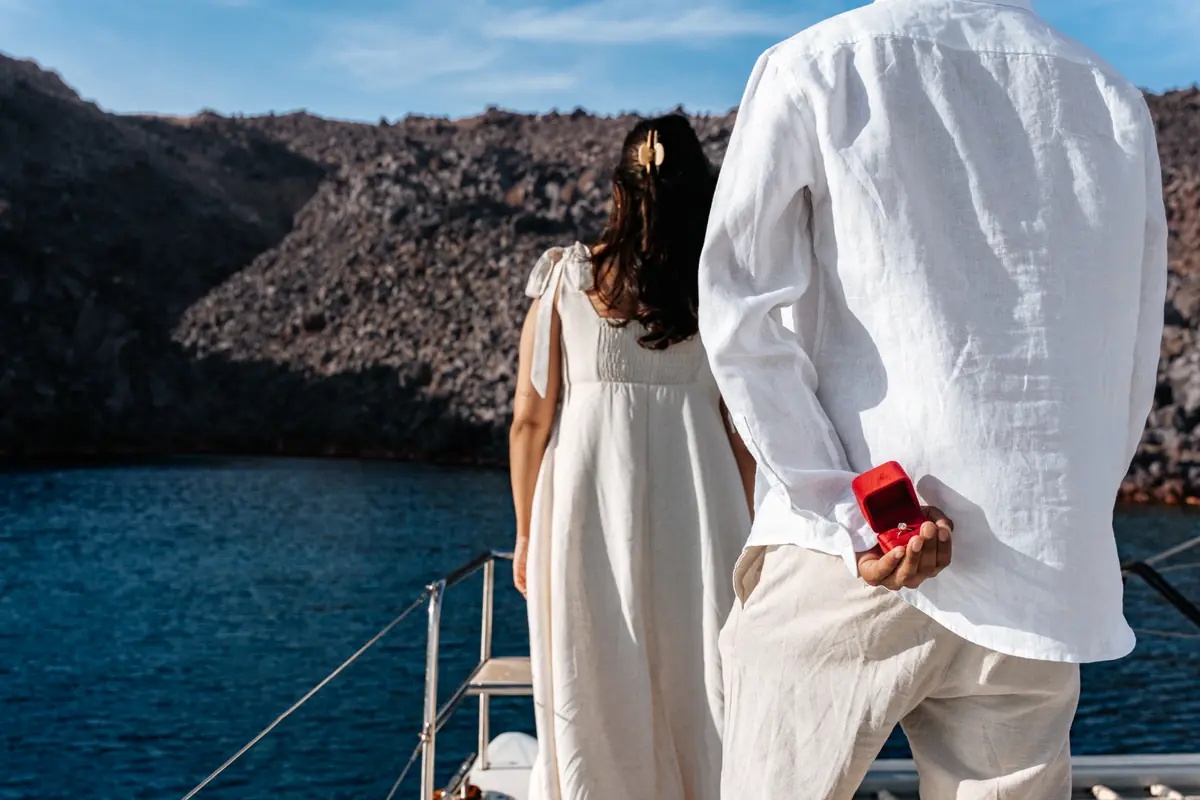
I have helped stage hundreds of proposals on this island, and the questions couples ask me are almost always the same: where, when, and how do I keep it a secret? This is the exact process we use — written so you can follow it whether you plan with us or on your own.
The short version: choose your spot and date first, lock in a sunset time, build a believable cover story, arrange styling and a discreet photographer, and rehearse the day-of timeline. Plan 4–8 weeks ahead in peak season. Below, each step in detail.
1. Decide the kind of moment you want
Before location, decide on feeling. Do you want the grand, iconic Santorini sunset — the one everyone pictures — or something hidden and completely private? Does your partner love a crowd and a celebration, or would they be mortified by an audience? Everything else flows from this answer.
As a rule of thumb: Oia delivers the famous skyline; Imerovigli offers the same drama with more breathing room; a private villa terrace or a catamaran gives you total seclusion. If you are unsure, our locations guide compares them honestly, including the trade-offs no one mentions.
2. Choose the spot — and check it's actually private
The single most common mistake I see is couples picturing a romantic, empty viewpoint that is, in reality, shoulder-to-shoulder at sunset. The public sunset spots in Oia fill up an hour ahead. If privacy matters to you, you need a terrace you can reserve, not a public ledge.
When we plan a cliffside proposal, we secure an exclusive terrace so you have the same caldera view with no strangers in your photos. If you're arranging it yourself, ask your hotel about a private terrace, or consider going out on the water — the open sea is the most private "viewpoint" of all.
3. Lock in the sunset time for your exact date
Santorini's caldera faces west, which is why the sunset is so extraordinary — and why timing is everything. Sunset shifts dramatically across the season: roughly 19:00 in April, as late as 20:50 in late June and July, then earlier again through autumn. The magic happens in the 20–30 minutes before the sun touches the horizon, when the light turns gold.
Work backwards from that golden window. You want to be in position, relaxed, at least 30–45 minutes before sunset — not rushing up steps as the light fades. Build your dinner reservation, transfer and "cover story" around that anchor time.
4. Build a cover story that holds
This is the part people underestimate. A surprise unravels not at the moment, but in the hours before — a suspicious "where are we going?", an overheard phone call, a too-fancy outfit for a "casual" walk. Decide in advance:
- Why are you dressed up? A sunset dinner reservation is the most natural reason to look nice.
- Why are you going to that spot? "The hotel recommended this viewpoint" or "I booked us a drink here" works perfectly.
- Who else knows? The fewer people, the safer. If family or friends are involved, brief them clearly.
When we coordinate the surprise logistics, we set up the entire scene while you and your partner are elsewhere, so there is nothing to give the game away until the reveal.
5. Arrange the styling
A beautiful view is the canvas; styling is what makes it unmistakably yours. Even a few well-chosen elements — flowers, candles, a simple sign, soft music — transform a viewpoint into a moment your partner instantly understands was made for them.
Keep it to your taste. Some couples want a dramatic flower arch; others want one perfect bouquet and a cluster of candles. Whatever you choose, plan who sets it up, when, and who packs it away afterward. (If you're doing this yourself, remember that candles and wind do not mix on an exposed cliff — choose hurricane lanterns.) See our approach to proposal design & styling.
6. Hire a photographer — discreetly
You will not remember the details as clearly as you think; the adrenaline erases them. A photographer is the one investment couples never regret. The key is discretion: a good proposal photographer positions themselves so your partner doesn't notice until after you've asked, capturing the genuine reaction rather than a posed one.
Brief them on the plan — where you'll stand, which direction you'll face (toward the light), and a discreet signal for when you're about to ask. Read our notes on photography & videography for what to look for.
7. Plan for the weather
Santorini is reliably sunny from April to October, but it can be windy, and wind is the enemy of cliff-edge candles and calm seas. Always have a backup: a sheltered terrace, an alternative time, or an indoor-outdoor space. We agree a weather plan with every couple in advance so a gust never becomes a crisis. If you're self-planning, identify your "plan B" before the day, not during it.
8. Rehearse the day-of timeline
On the day, a simple written timeline keeps everyone calm. Ours typically looks like this:
- ~2 hours before sunset: the team sets up the styling in secret.
- 45 minutes before: you arrive; the photographer is already in position.
- Golden hour: you ask.
- After "yes": champagne, photos, and the sunset to yourselves.
Have the ring somewhere secure but accessible (a jacket pocket beats a bag), keep your phone on silent, and breathe. You have planned well; now you get to enjoy it.
9. Plan the celebration
The moment she says yes, the night is just beginning. Decide in advance whether you want an intimate dinner for two, a surprise gathering of friends, or simply a quiet drink to let it sink in. Many couples also book a relaxed couples' photo session the next day, in their favourite outfits, to capture the joy without the nerves. See ideas for the post-proposal celebration.
You get one moment to ask. Spend your energy on the story and the feeling — and let someone else handle the logistics.
How far in advance should you plan?
In peak season (May–October), I recommend 4–8 weeks. The best private terraces and photographers book out, and rushing narrows your options. That said, we have created beautiful proposals on a few days' notice — if your dates are close, just ask and we'll tell you honestly what's possible.
If reading this has confirmed that you'd rather not project-manage your own proposal from another country, that's exactly what we're here for. Tell us your story and we'll design and stage the whole thing — you just bring the ring and the question.

Eleni Marinou
Founder & Lead Proposal Designer
Eleni founded Proposal Santorini and has personally designed proposals across the island for over a decade. She lives in Oia and speaks Greek, English and French. Meet the team →