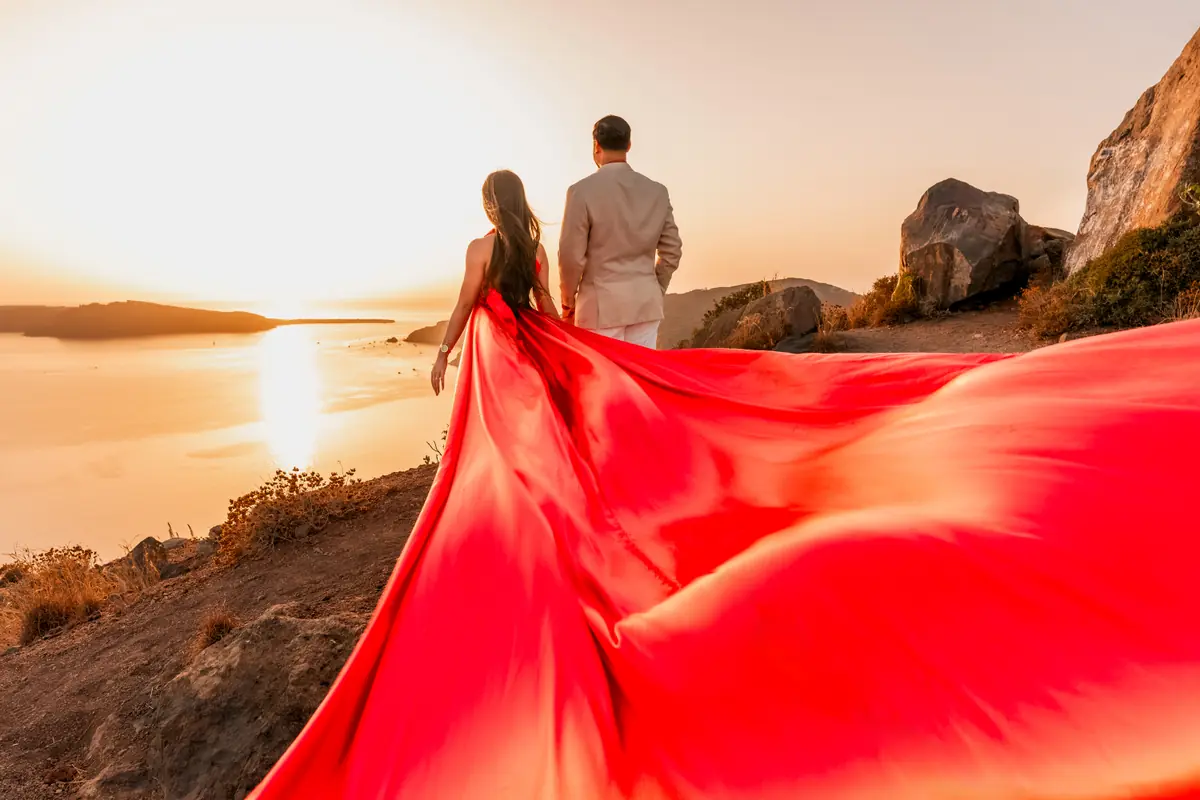
Almost every proposal we stage is timed to the sunset, so I've watched the sun drop over this caldera more evenings than I can count. The single most useful thing I can give you is this: know your sunset time before you book anything else, because in Santorini that time moves by nearly two hours across the season. Here is the month-by-month picture, and what each one actually feels like to ask in.
The short version: Santorini sunsets range from about 18:05 in November to roughly 20:50 in late June. The magic isn't the moment the sun vanishes — it's the 20–30 minutes before, when the light turns gold. Plan to be in position 30–45 minutes ahead. The figures below are approximate; always confirm the exact time for your date.
Why timing matters more here than almost anywhere
Santorini's caldera faces west. That orientation is the whole reason the sunset is famous — the sun sinks straight into the open Aegean with nothing in the way. But a west-facing cliff also means the light changes fast and dramatically. Arrive late and you miss the gold; arrive flustered and out of breath and you ask in the wrong frame of mind. Treating the sunset time as the fixed anchor of your entire evening is the difference between a rushed proposal and a serene one.
Spring — April & May
Sunsets run roughly 19:50 to 20:20 across these months. Spring is, quietly, my favourite season to propose. The island is in bloom, the air is clear, the crowds haven't peaked, and the light has a soft, washed quality. Evenings can still carry a cool breeze, so bring a wrap and plan a sheltered option. If you want the famous view without the high-summer scrum, this is the window I'd choose.
Early summer — June
June pushes sunset to its latest — around 20:45 to 20:50 by the solstice. This is peak romance: warm, dry, long golden evenings and the sea at its calmest. It's also the start of the busy season, so the public viewpoints fill early and the best private terraces and photographers book out weeks ahead. If you're proposing in June, secure your spot well in advance — see how we reserve an exclusive terrace for the Caldera / Cliffside Proposal.
High summer — July & August
Sunset eases back slightly to about 20:20 to 20:45. The light is gorgeous and reliably clear, but two things to plan around: the heat (a late-evening proposal is far more comfortable than a midday one) and the meltemi, the strong seasonal north wind that can pick up in the afternoons. Wind matters for cliff-edge candles and for anything at sea — we always agree a weather plan, and so should you. These are also the most crowded weeks of the year, which makes a reserved private setting more valuable than ever.
Early autumn — September & October
Sunsets move earlier, roughly 19:40 in September to 18:45 by late October. For many couples this is the sweet spot of the whole year: still warm, the sea still swimmable, the wind usually calmer than August, and the crowds thinning week by week. The earlier sunset also means a gentler evening timeline — you can have your golden-hour moment and still enjoy a relaxed, unhurried dinner afterward.
Late autumn & winter — November to March
Sunset falls between about 18:05 and 18:30 in this stretch (a touch later as spring approaches). The island is quiet and intimate, with dramatic skies and the caldera almost to yourselves — beautiful for couples who want seclusion and don't mind cooler, more changeable weather. Some venues close for the season, so options narrow and an indoor-outdoor backup becomes essential. A winter proposal here can be deeply romantic; it simply needs a little more flexibility built in.
How to read these times for your exact date
The figures above are seasonal averages, and sunset shifts by a minute or two each day. Once you've fixed your date, look up the precise sunset time for that day and treat it as the centre of your plan. Then work backwards:
- Golden window: the 20–30 minutes before sunset — this is when you ask.
- In position: 30–45 minutes before sunset, relaxed and settled, not rushing up steps.
- Styling set up: we typically begin around two hours before, while you're elsewhere.
- Dinner: book it after the golden window, so nothing competes with the moment.
A worked example: timing a June proposal
Let me make this concrete. Say you're proposing in mid-June, with sunset around 20:48. Here's the evening I'd build: styling set up discreetly from about 18:45 while you're at a "pre-dinner drink" elsewhere; you arrive at the terrace, relaxed, by 20:05; the photographer is already in position; you give the signal and ask at roughly 20:25, deep in the golden window; champagne and photos through the afterglow; and your dinner table booked for 21:15, so nothing competes with the moment. Notice how everything hangs off that single 20:48 anchor. Shift the month and every number slides with it — which is exactly why the sunset time is the first thing we confirm.
Don't overlook the blue hour
One window couples rarely plan for, and often love most, is the blue hour — the twenty or so minutes after the sun has gone, when the sky deepens to indigo and the village lights begin to glow. If your partner is camera-shy or you'd prefer something softer than the blaze of full sunset, asking just into the blue hour gives you a calmer, more intimate palette and gorgeous low-light photographs. It's also a graceful fallback on a hazy evening when the sunset itself underwhelms. A good photographer will know how to work both windows, so you're covered either way.
Don't ask as the sun disappears. Ask in the gold just before — that's when the whole sky is on your side.
Location changes your timing too
Where you stand affects when the light works for you. In Oia, the headland means the sun sets cleanly into the sea but the crowds gather a full hour ahead. In Imerovigli, the high vantage holds the light a little longer and stays calmer. Out on a catamaran, you keep the sun in view the longest of all. Compare every vantage point in our locations guide, and once you know where, our timing only gets more precise.
A note on weather and the "perfect" sunset
Not every evening delivers a flawless gold-and-crimson sky — a few are hazy or cloudy, and a dramatic cloudy sunset can actually be the most beautiful of all. What we control is the timing and the calm; the sky does what it does. That's exactly why we build a backup into every plan, so a less-than-perfect forecast never derails the moment. If you'd like us to handle the timing, the terrace and the contingency for your specific date, send us your dates and we'll map the whole evening around your sunset.

Eleni Marinou
Founder & Lead Proposal Designer
Eleni founded Proposal Santorini and has personally designed proposals across the island for over a decade. She lives in Oia and speaks Greek, English and French. Meet the team →